Pediatric developmental milestones - What you need to know while watching your child grow
As a parent, the health and well-being of your child is a top priority. As they grow, you’ll be their biggest fan but you’ll also be observing them closely looking for any sign of trouble.
During their most crucial ages, you may be questioning what is considered as normal development. Instead of Googling and wondering, having pediatric therapists as a resource, you can take advantage of experts who can not only assess and test your child, but who can also partner with you directly for questions and support along the journey of growing.
Let’s learn more.

What are the areas of focus in child development?
In working with your pediatrician, talking to other parents or falling down the internet or social media rabbit hole, you may have heard of pediatric milestones. These are general guidelines or a template for when your child should be achieving certain tasks.
When looking at benchmarks, they are broken out into four main categories:
- Physical development: Fine and gross motor skills.
- Cognitive development: Learning, memory and problem-solving skills.
- Language development: Producing speech sounds, creating sentences and using first words.
- Social and emotional development: Playing with people and expressing feelings.
Knowing these milestones gives you a better understanding of your child’s development progress and identifies areas that could require assistance.
How do developmental milestones help you make decisions for your child?
As a parent, being familiar with pediatric milestones helps you know where your child is and what’s coming next. The truth is, child development follows a fairly predictable schedule. Milestones occur in a relatively expected order and during specific times in a child’s life. These stages are vital because one area of development relies on mastering the skills on the area before it.
While the development schedule is predictable, no two children are really the same, so pediatric therapists look at your child and assess if they are meeting the basic skills by the end of that range. If they are not hitting those marks, they step in to boost their development and get them on track.
Pediatric therapy includes physical therapy, occupational therapy and speech-language pathology (speech therapy). All have focused areas of rehabilitation expertise, but they also work together to tie all pieces of the development puzzle together.
What to expect at a pediatric therapy assessment appointment
- Paperwork and history: You'll share your child's medical, development (milestones like walking, talking) and family history, plus current challenges.
- Observation and play: The therapist(s) uses toys, puzzles and games to observe skills like balance, coordination, speech or focus.
- Assessment: They'll assess specific areas. Our rehabilitation experts look at gross motor skills (use of large muscles for movement) and fine motor skills (use of small muscles for precise movement), speech sound production, understanding and use of language as well as thinking processes and ability to interact with others to identify challenges.
- Discussion and plan: You'll discuss findings, set goals and learn about recommended next steps, like ongoing therapy.

Important age-based milestones
While each year of life has certain distinct milestones, this blog will explore them in larger age ranges. Additional resources are shared at the end of the blog, if you, as a parent, want to look at your child through each year of development.
Remember, milestones are meant to be achieved by the end of the ranges provided.
Infants 0-12 months
- Gross motor – Moving from sitting to standing in a coordinated way, having full body coordination, having controlled starts and stops to walking.
- Fine motor – Starting to scribble, able to hold a crayon or pencil and being able to move things from one hand to another.
- Language – Answering when someone calls the child’s name (even a non-verbal turn and look), making sounds or copying sounds they hear, making gestures like waving, pointing or showing an object, interested and responsive to music.
- Social – Grinning, identifying faces, some imitation of facial expressions, maintaining eye contact through play interactions, bringing things to caregivers, being able to be comforted by a parent or caregiver.
Ages 1 to 3 years
- Gross motor – Jumping in place with feet together, switching feet and going up and down the stairs.
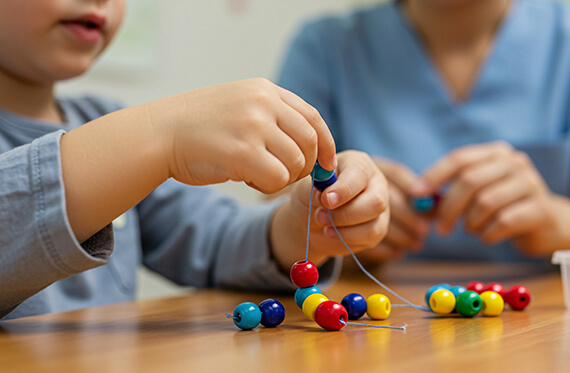
- Fine motor – Able to do more precise skills like placing beads on a string, using child scissors to snip at paper, doing simple insert shape puzzles, holding a pencil or crayon with a maintained and coordinated grasp.
- Language – Starting at age 2, having 50 words in their vocabulary and combining two or more words together. Following two-step directions. Responding to who, what, where questions about their immediate environment. Starting to respond to questions. Responding with gestures such as a reach or a point and eventually words. Indicating yes or no. Ability to look at books and pictures - viewing, managing or interacting with photos.
- Social – Parallel play, not interacting but working side-by-side to complete an activity. Looking at people during conversations and indication of understanding the back-and-forth of communication. Recognizing basic emotions. Showing more desire for independence instead of being guided through everything. Avoiding common danger. Engaging in music, songs, routine play and television. Starting to participate in turn-taking, passing things around.

Preschoolers ages 3 to 5
- Gross motor – Hopping, bouncing a ball and catching it.
- Fine motor – Doing arts and crafts. Using child scissors more meaningfully and precisely. Mastering a tripod grasp to hold a pencil or crayon, using three fingers consistently.
- Language – Full sentence speech where grammar is not 100% but expressing ideas through words. Able to fully understand the message they are trying to convey. Able to retell an immediate event. Should be able to define simple words. Starting to follow longer directions with two or three steps while understanding relationships between people, objects and location such as color, numbers and shapes, over, under and behind.
- Social – Cooperative play - playing together and taking turns. Following the rules of a game (hide and seek, duck-duck-goose). Enjoying and understanding competition in play. Identifying and communicating feelings and responding to other people’s feelings.
School age 5 and plus
- Gross motor – Skipping, jumping, hopping with good body awareness.
- Fine motor – Better writing and coordination of abilities including efficient writing or doing what is required of them in school without becoming too fatigued or frustrated. Being able to cut out shapes and complete art projects.
- Cognitive and language – Shift in learning basics of language to understanding and using language to learn. Following multi-step direction and problem solving. By age 6, having fully developed speech sounds and more mature sounding speech. Grammar is getting more accurate. Keeping on pace with school vocabulary, comprehension, the ability to listen to a story and retelling it or reading a story and being able to answer questions related to it.
- Social – Creating connections, maintaining friendships and controlling feelings.
Taking control through early intervention
The sooner developmental difficulties are recognized and addressed, the better the results. Children from birth to age 3 are the target of early intervention programs, which emphasize the development of important skills during this vital time.
Early intervention also prevents the domino effect. Children who fall behind on one milestone have a harder time meeting the next milestones. If they are not developing the motor skills that allow them to explore their environment, they are likely to fall behind in language. One area impacts the next.
Your child can gain the following advantages through early recognition of challenges and taking the steps to address them.
- Better communication and motor abilities.
- Improved emotional and social development.
- Enhanced self-assurance and self-reliance.
Working with professionals who are knowledgeable in therapy techniques, parents may assist their children in laying a solid foundation for success in the future.
When to seek pediatric therapy and how to choose a provider
The first step is to be familiar with developmental milestones. If they seem to be falling behind talk to your pediatrician or seek out pediatric therapy directly. Specially trained therapists use certain techniques to address delays and promote your child’s development, helping them to catch up.
Here are a few warning signs to watch for:
- Difficulty using hands, walking or crawling.
- The inability to concentrate, learn or solve issues are examples of cognitive differences.
- Limited vocabulary or trouble interpreting language are examples of speech delays.
- Difficulties playing with classmates or maintaining eye contact.
When choosing a therapy provider, take into consideration:
- Credentials – Seek certified experts with pediatric therapy expertise.
- Therapy approaches – Make sure the center provides therapy techniques that are specifically suited to your child’s requirements.
- Involvement of parents – Select a provider who emphasizes working together with parents.
- Environment – Your child’s comfort and involvement might be improved by a warm, kid-friendly environment.
- Convenience – Choose a location where you can easily make appointments and keep them. Consistency and routine are key to success so making it to every appointment, and doing homework in between, improves results.

Be part of the solution – parents and therapists working together
A good pediatric therapy program reports results back to the child’s primary provider or pediatrician and involves the parents in all aspects of care. A great program includes therapists who take the time to understand how parents learn best and stay informed (social media, blogs, online resources, podcasts, etc.) and then provide resources to help parents understand what is going on with their child.
When parents are on the same page with the therapy program and involve themselves in the appointments, learning techniques and strategies for the child and provide feedback on how the program is or is not working, everyone wins. Therapists adjust the care plan or explore new techniques that speak best to the way the child learns and remains engaged.
When lines of communication are open between parents and therapists, existing care plans have better results. If more challenges become apparent in the future, follow-up programs can be created.
Pediatric therapy can also be a form of reassurance that children are on track. If you’re not sure, and want a professional opinion of where your child falls on the milestone path, a pediatric assessment can rule out any concerns or set you up for any needed intervention.
Don’t play the guessing game when it comes to your child’s development, choose pediatric therapy.
Clinical contribution to this blog provided by Speech-Language Pathologist Grace Eisenhuth and Occupational Therapist Dominique Gousset.
Additional Resources:
Resources recommended by our pediatric therapists for distinct, yearly milestones, checklists and guidance:
Milestones in the four key areas of development
American Academy of Pediatrics
U.S. Centers for Disease Control and Prevention (CDC)
Communication and feeding skills - American Speech-Language-Hearing Association